


The price of an HR tech company is set by the buyers who compete for it, not by a multiple. Five types of buyers acquire HR software today: large software and HR groups, mid-sized companies, private equity funds, fund-backed buy-and-build platforms and individual buyers. Each one values the same company differently, so a sale process that brings several types to the table at the same time is the most reliable way to reach the top of the price range.
This article explains who buys HR tech companies in Europe, why each buyer type pays for different things, and how to run a process that puts them in competition.
Who buys HR tech companies?
HR tech is consolidating fast. In workforce management software alone, Raisers Partners counted 13 deals in Europe between January and November 2026: 9 acquisitions by software companies and 4 equity stakes taken by funds. The buyers fall into five groups.
| Buyer type | Recent examples (2025-2026) | What drives them |
|---|---|---|
| Large software and HR groups | SAP acquired SmartRecruiters; Workday acquired Sana for $1.1bn; Sage acquired Criterion HCM; Protime (SD Worx group) acquired Checks; Mercer acquired ConvictionsRH | Filling a gap in their suite and selling it to their installed base |
| Specialist software vendors and mid-sized companies | Octime acquired Qoia; Paralax acquired YouPlan; Logobject acquired Ethelred and Planik; Worklinq acquired Time Key | Adding a product, a customer segment or a country |
| Private equity funds | Bridgepoint took a stake in Skello; Fortino Capital in Shiftbase; Accel-KKR in tamigo; Expedition in Nesto | Cash generation, recurring revenue, a management team that stays |
| Fund-backed buy-and-build platforms | Kinara, a fund-backed workforce management platform, acquired Lamster | Add-ons that extend the platform, bought at a lower multiple than the platform itself |
| Individual buyers | Managers taking over a company (MBI), search funds; 2 of the 8 offers in the typical deal described below | A profitable, stable business they can finance with debt |
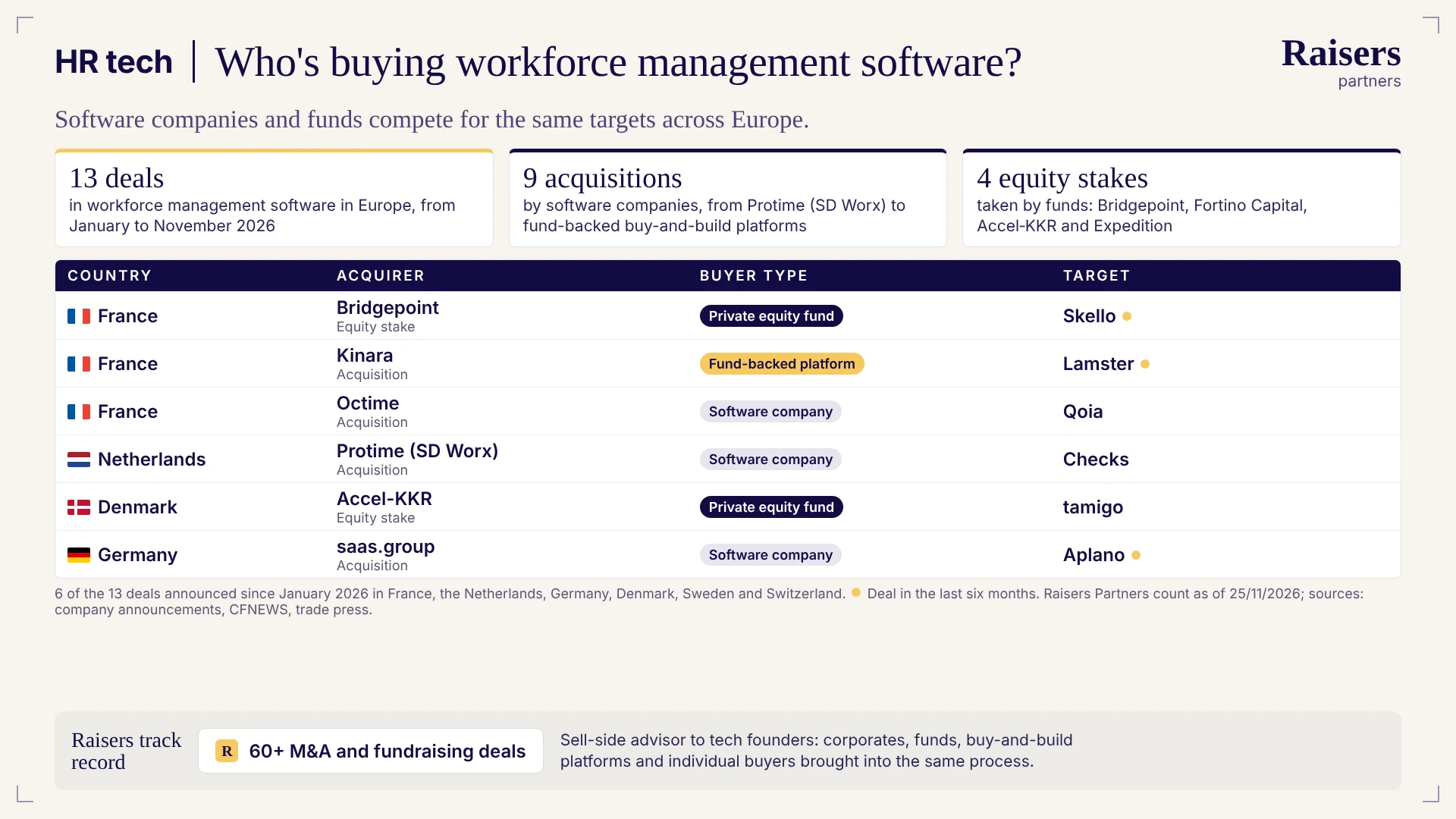
Sources: Raisers Partners count of workforce management deals as of 25 November 2026 (company announcements, CFNEWS, trade press); NexaRH and RH Matin for the large-group deals. Deals by individual buyers are rarely announced, so no public examples are listed.
Why does widening the buyer mix raise the price?
Because each buyer type prices the same company with a different logic, and the best offer comes from the buyer whose logic values your company most. You cannot know in advance which one it will be.
- A strategic buyer prices the synergies: how much of your product it can sell to its own customers, and what it would cost to build it in-house. That is why strategic buyers can pay above what the financials alone justify.
- A private equity fund prices cash generation and the debt the company can carry. It pays for predictability: recurring revenue, low churn, a team that stays.
- A buy-and-build platform prices your company as an add-on. It can pay a solid price because adding you raises the value of the whole platform.
- A mid-sized company prices the market access you bring: a segment, a country, a product line.
- An individual buyer prices what a bank will lend against your profits. Offers are lower on average, but often faster and with a seller who stays involved for a transition period.
When only one buyer type is approached, offers cluster around that type's logic. When three or four types compete on the same timeline, the seller can compare structures, not only prices: cash at closing, earn-out, reinvestment, role of the founder after the deal.
For reference, HR tech companies sell for 3x to 6x their annual recurring revenue (ARR), and potentially more above €10m of ARR, according to Raisers Partners. Where a company lands in that range depends largely on who is bidding.
What does each buyer type look at?
The same data room is read five different ways. Preparing for all of them is what makes a multi-buyer process possible.
| Buyer type | First question | Key metrics | Typical deal structure | Watch out for |
|---|---|---|---|---|
| Large software and HR groups | Does it fill a gap in our suite? | Product fit, integration effort, overlap of customer bases | Mostly cash, sometimes an earn-out tied to integration | They may be competitors: disclose sensitive data in stages |
| Mid-sized companies | Does it open a segment or a country? | Revenue by segment, customer concentration, team | Cash, sometimes partly in shares | Financing capacity varies a lot from one buyer to another |
| Private equity funds | Can it carry debt and grow? | Recurring revenue, EBITDA, cash conversion, churn | Majority stake, founder reinvests a share | They usually want the founder to stay several years |
| Buy-and-build platforms | Does it extend the platform? | Recurring revenue, gross margin, product compatibility | Full acquisition, cash plus possible reinvestment in the platform | They usually want the founder to stay several years |
| Individual buyers | Can I finance it and run it? | Profitability, stability, dependence on the founder | Senior debt, vendor loan, earn-out | Lower price ceiling; financing must be secured before signing |
For HR software specifically, every buyer type also checks regulatory exposure (payroll and labour law updates), data protection compliance for employee data, and integrations with payroll engines and HRIS.
How do you run a sale process with several buyer types?
The goal is to have every relevant buyer type reach the offer stage in the same weeks. Five steps make it work.
- Prepare the numbers every buyer type will ask for, before approaching anyone: recurring revenue and its growth, churn and net revenue retention, gross margin, EBITDA, cash conversion, revenue by customer segment.
- Map the buyers by type, not only by name: suite vendors and HR groups, mid-sized players in adjacent segments, funds active in HR software, fund-backed platforms looking for add-ons, and, for profitable companies, qualified individual buyers.
- Adapt the pitch to each type: synergies and product fit for strategic buyers, cash flow and debt capacity for funds, fit with the platform for buy-and-build groups.
- Run one timeline for everyone: same date for indicative offers, same date for binding offers. A buyer who knows others are bidding on the same calendar bids closer to its maximum.
- Protect sensitive data: share customer names, pricing and product roadmap in stages, especially with buyers that compete with you.
The outcome is not only a higher price. Comparing offers from different buyer types also lets the founder choose the structure that suits them: full exit, partial reinvestment, or staying on to run the next phase.
A typical HR tech deal: 8 offers, 4 buyer types
Take a typical HR tech sale run by Raisers Partners: a French HR software company with recurring revenue, whose founder wanted a full exit.
Raisers Partners advised the founder. The company came to market fully prepared, with precise SaaS KPIs and consolidated financials, which allowed the team to approach every buyer type in parallel. The process produced eight written offers from four buyer types: three corporates, two buy-and-build funds, one more classic LBO fund and two individual buyers.
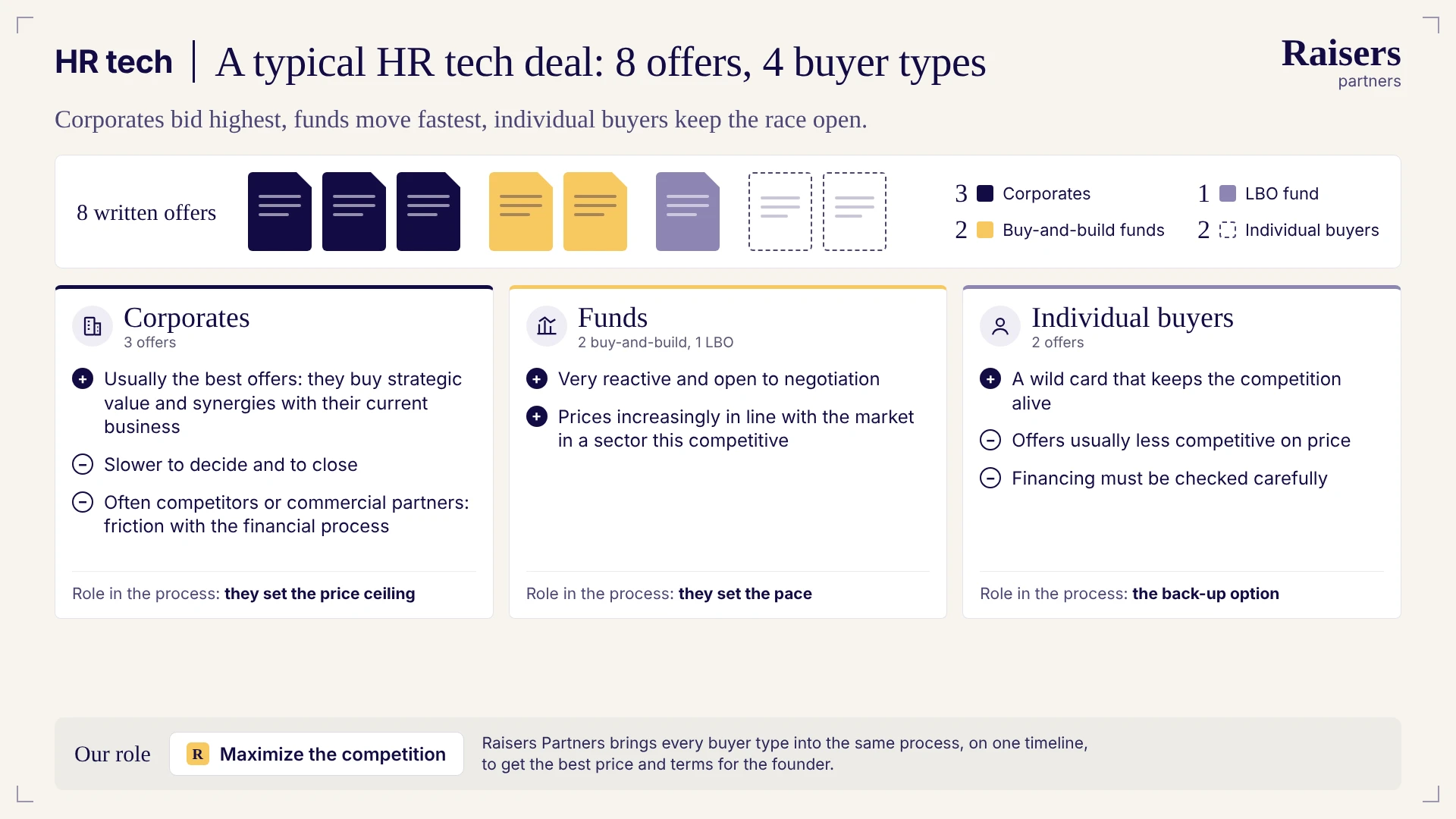
What the process showed about each buyer type:
- Corporates usually make the best offers, because they can pay for strategic value and for synergies with their current business. But they are slower, and they raise operational issues: they are often competitors or commercial partners, which collides with the financial process.
- Funds are very reactive and open to negotiation, and in a sector as competitive as HR tech, their prices are increasingly in line with the market.
- Individual buyers are the wild card: they keep the competition alive, but their offers are usually less competitive on price, and the seriousness of their financing must be checked.
The company was sold to a buy-and-build platform: the buyer that combined a market price with the speed and flexibility of a fund.
The lesson for any HR tech founder: corporates set the price ceiling, funds set the pace, and individual buyers are the back-up option. Bringing all three to the table on one timeline is what turns a sale into a competition.
Case study: RHIS Solutions
RHIS Solutions is a French workforce management and time-and-attendance software for multi-site restaurant networks, with about 50,000 users across more than 1,400 sites. In January 2026 it joined TOL Développement, the multi-vertical software platform of Cervinvest Capital, which had already invested in workforce management through Truckonline.
Raisers Partners advised the founder. The company came to market fully prepared, with precise SaaS KPIs and consolidated financials, which allowed the team to approach strategic acquirers and fund-backed software platforms in parallel. The process produced eight written offers, according to the founder, and ended with a buy-and-build platform: the buyer type that could value RHIS as a building block of a wider group.
Thinking about selling your HR tech company?
Every company attracts a different mix of buyers. Let's talk about your situation: which buyers could be interested, how they would value your company, and when to start preparing.
Book a call with Augustin de Cambourg, Partner →
Sources
- Raisers Partners, count of workforce management software deals in Europe, January to November 2026 (company announcements, CFNEWS, trade press)
- NexaRH, HR Tech market 2025: the acquisitions consolidating the market (published November 2025, updated December 2025)
- RH Matin, Mercer acquires ConvictionsRH
- Raisers Partners, RHIS Solutions is sold to Cervinvest
NexaRH and RH Matin are third-party sources.